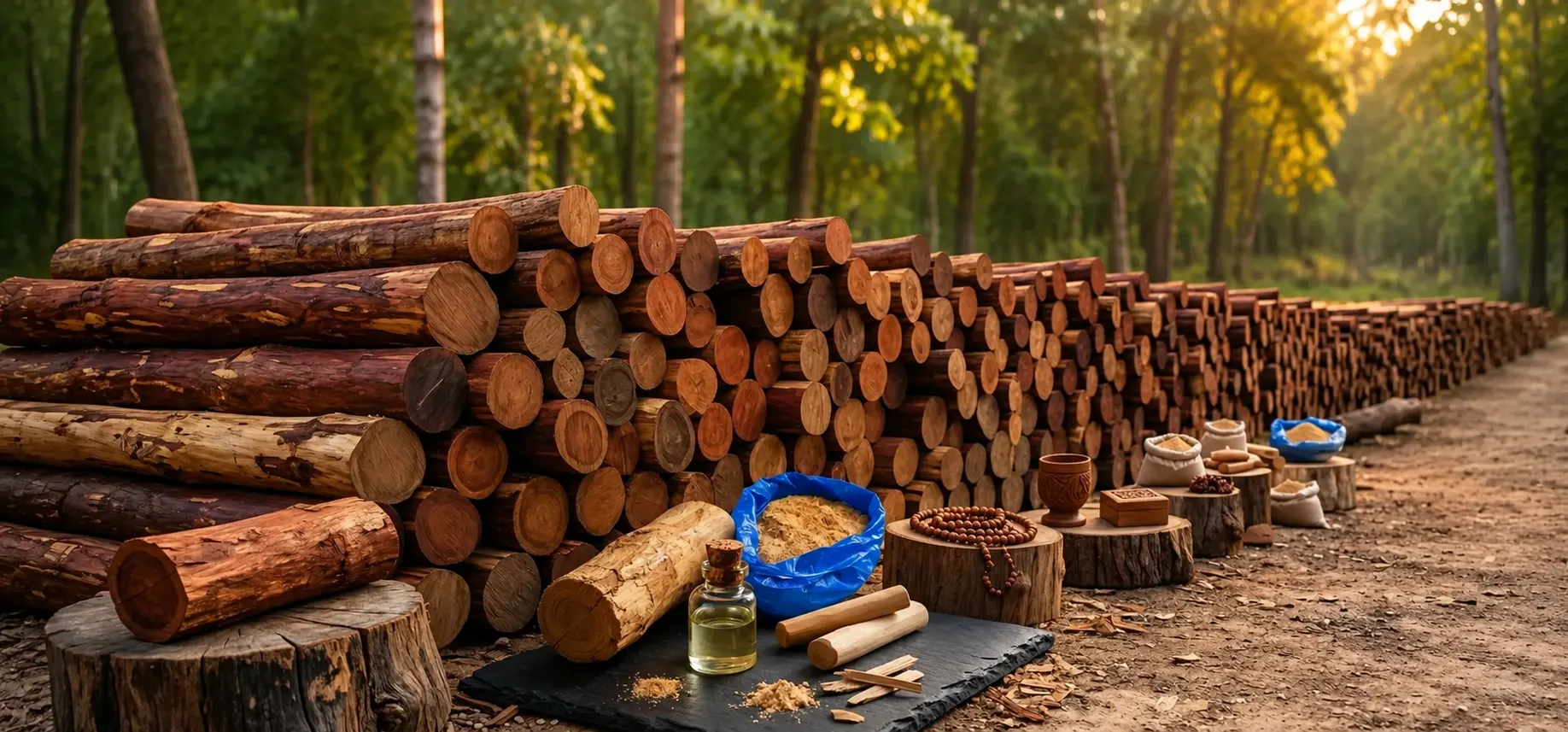
From ancient carving and dye to modern scarcity and regulation, how this tree became one of the world’s most valuable timbers.
Published 2025-02-11, Updated 2026-07-05, By Shree Editorial Desk
Quick answerRed sandalwood has been valued for centuries, used historically in carving, fine furniture, musical instruments and as a natural red dye, and traded from its narrow home range in the southern Eastern Ghats to markets across Asia. Over time, high demand met a naturally limited supply, and pressure on wild trees led to the strict regulation and CITES protection we see today. This article sketches that arc honestly, without inventing specific figures, to explain how a regional tree became a globally controlled, high-value timber, and why legal cultivation now matters.
An old and prized wood
Red sandalwood’s dense red heartwood has been valued for a very long time, in carving and fine furniture, and as a source of natural red colour. Its worth is not a modern invention; it is rooted in centuries of use.
Demand met limited supply
Because the tree grows naturally only in a small region and matures slowly, supply was always constrained. As demand, particularly from East Asian markets, persisted, that imbalance pushed value up and put pressure on wild stands.
From open trade to strict control
Sustained demand and scarcity drove overharvesting of wild trees.
Protection followed, including CITES Appendix II listing.
Today, harvest, transit and export are tightly regulated.
Why cultivation is the modern chapter
Legal, documented plantations are the current response to that long history: a way to meet demand without stripping wild forests. For the regulatory detail, see legal status and our research note on CITES.
SH
Shree Editorial Desk
Shree Properties & Projects, editorial
Run the ten checks on us
Request the due-diligence pack and hold us to this guide.